
Journal
How to charge and store an electric bike battery – charging time, winter, temperature and lifespan
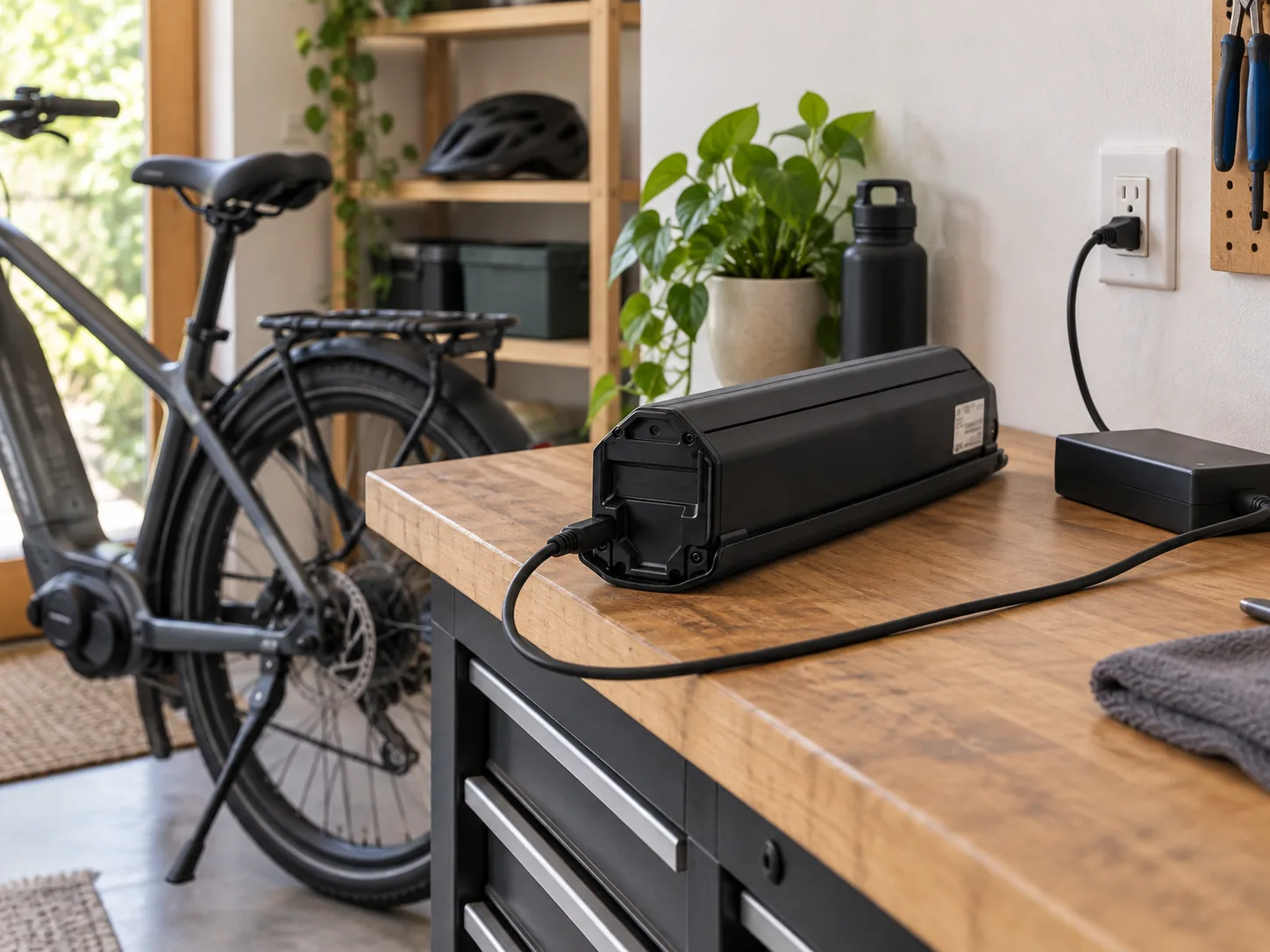
How to charge and store an electric bike battery – charging time, winter, temperature and lifespan
How do you charge an electric bike battery, how long does it take, do you have to wait for it to drop to 0%, can you top it up, and how should you store it in winter? The right care matters both for everyday use and for the long-term life of the battery.
In this guide we bring together the essentials on charging, charging time, storage, temperatures, winter and summer use, cycles, ageing and signs of a problem. We also cover one important detail: there is no single universal rule for every e-bike battery – the recommendations of MTF and Shimano, for example, are not entirely the same.
Last technical check: September 2026
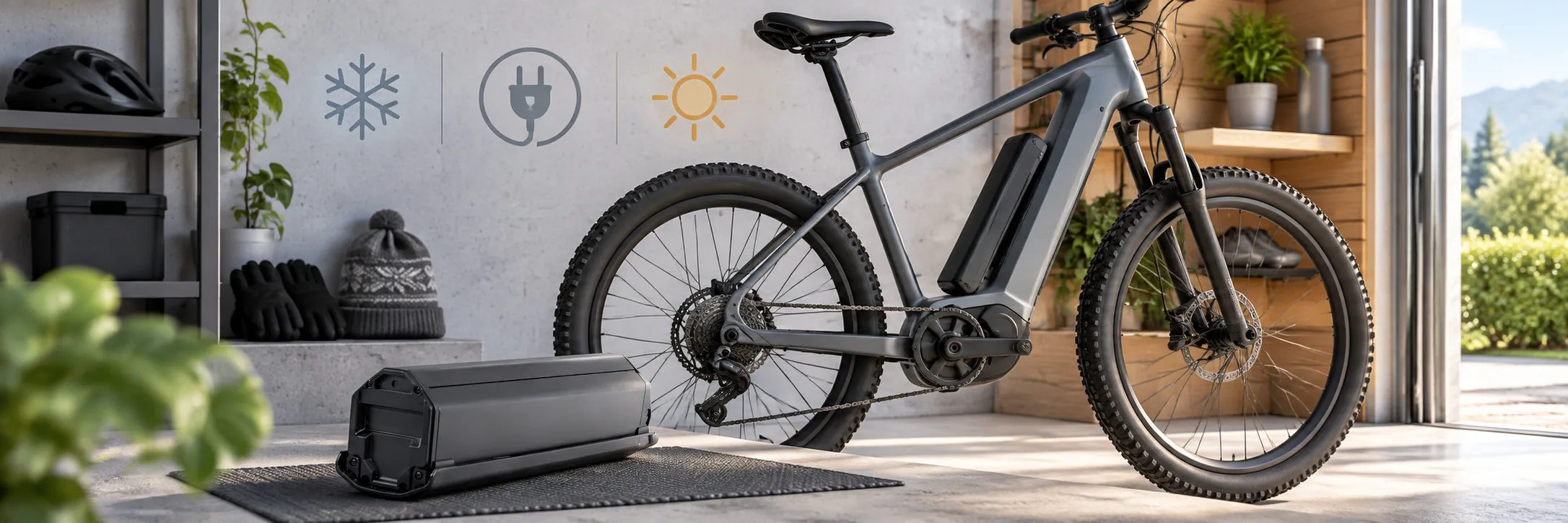
The electric bike battery in brief
No need to wait for 0%
A modern Li-Ion battery can be topped up. You do not need to run it completely flat before every charge.
Topping up is normal
MTF Li-Ion batteries do not have the characteristic memory effect of older rechargeable technologies.
MTF: 70–90% for storage
For long-term storage, MTF recommends keeping the battery at roughly 70–90% rather than leaving it discharged.
Temperature matters
For MTF, storage at roughly 10–25°C is recommended, with around 20°C being a suitable temperature for a long life.
Cold can reduce range
At low temperatures, the available capacity and real-world range may temporarily be lower.
Beware of heat
Do not leave the battery for long periods in direct sunlight or in a very hot car.
If your main question is how many kilometres an e-bike can really cover, see also the guide “Electric bike range – what it depends on” . If you are still choosing a bike, our guide to choosing an electric bike is also useful.
How do you charge an electric bike battery correctly?
With MTF, the battery can be charged either removed from the bike or fitted to it, where the design of the specific model allows. When charging the bike, the electrical system must be switched off.
A practical charging routine
Check the battery
Before charging, inspect the casing, connectors and cables. Do not use a battery with visible serious damage, deformation or other unusual signs.
Use the right charger
The charger must be designed for the specific battery and meet the required electrical specifications.
Charge in a dry, suitable place
Choose a stable, dry surface, away from strong heat, direct sunlight and conditions outside the permitted temperature range.
Let the system manage charging
A modern battery uses electronics to manage the charging process. Follow the indicator on the charger or the bike, depending on the model.
Unplug the charger after charging
During long-term storage, the charger should not stay permanently connected to the battery and the mains.
705.6 Wh or 882 Wh – real MTF batteries with Samsung cells
Current MTF models with the Bafang M510 use Li-Ion batteries with Samsung cells in capacities of 705.6 Wh and 882 Wh. They are real examples of why we should not talk about “one standard e-bike battery”.
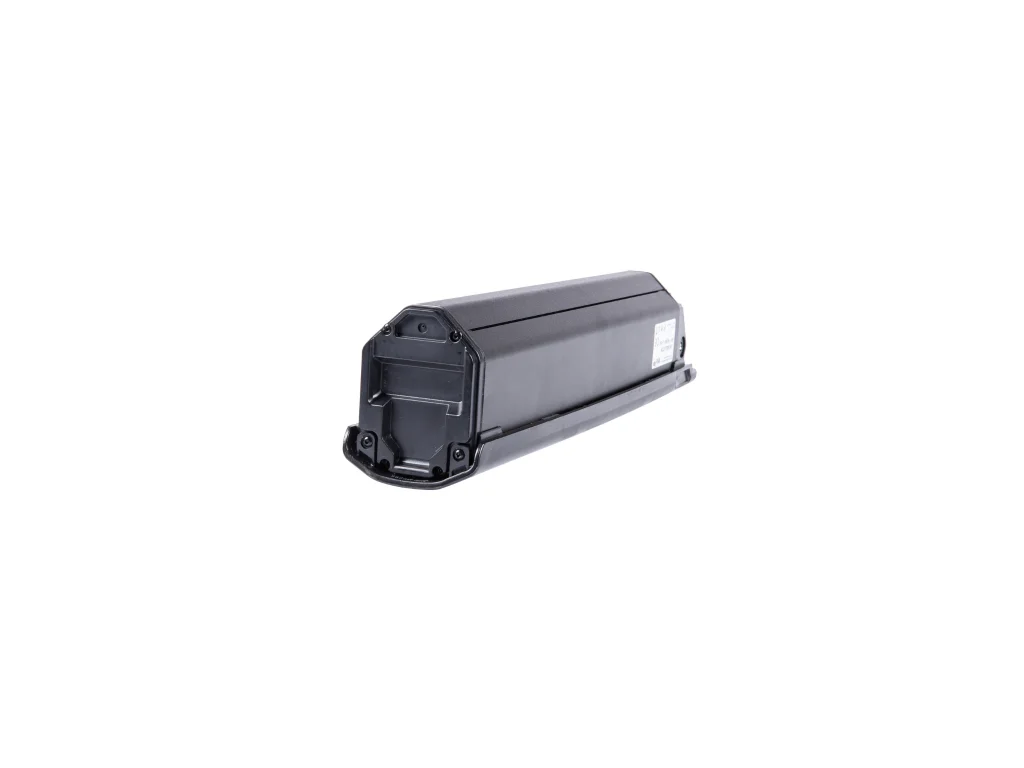
MTF 705,6 Wh
36 V / 19.6 Ah Li-Ion battery with Samsung cells. For models such as MTF Cross 7.5 W , the manufacturer states a maximum indicative range of up to 160 km.
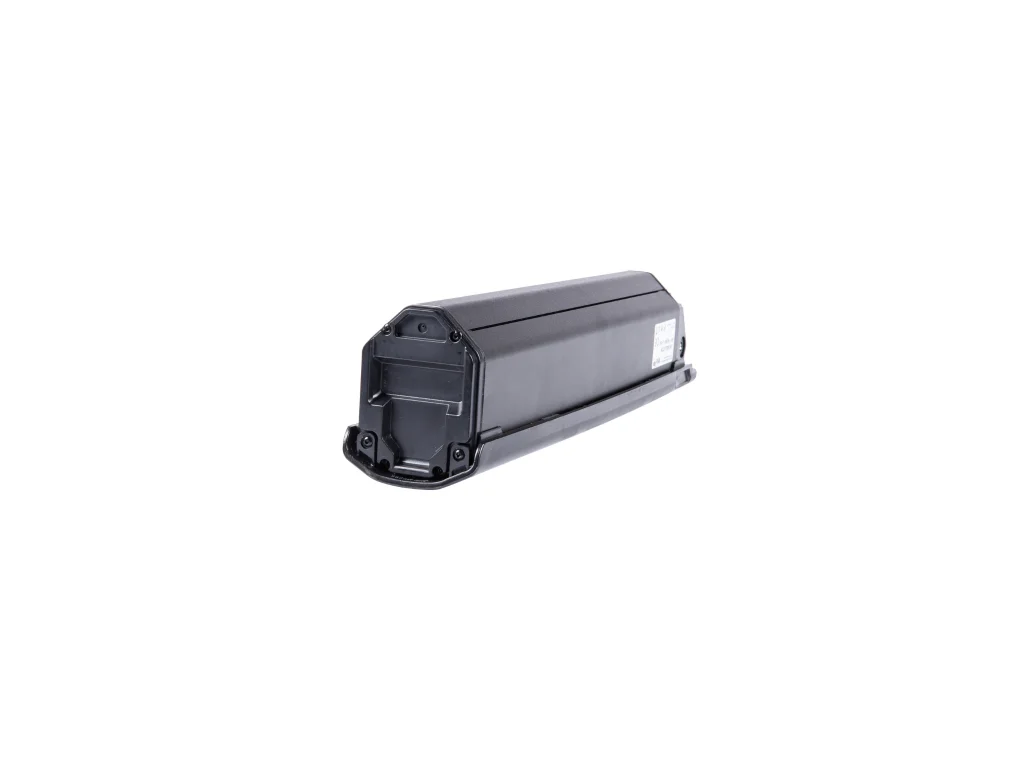
MTF 882 Wh
36 V / 24.5 Ah Li-Ion battery with Samsung cells. In suitable MTF configurations it offers a larger energy reserve, and for the Cross 7.5 W the manufacturer states a maximum of up to 200 km under certain conditions.
A larger capacity does not mean you will cover proportionally more kilometres in every situation. Real range depends on terrain, elevation gain, assistance mode, weight, temperature, tyres and riding style.
How long does an electric bike battery take to charge?
That is why a claim such as “every electric bike charges in 4 hours” is not accurate. A 468 Wh battery, a 705.6 Wh battery and an 882 Wh battery store different amounts of energy, and the chargers used can differ as well.
An example with current MTF models
On the MTF Cross 7.5 W, the 705.6 Wh and 882 Wh batteries work with an MTF 36 V / 3 A charger. The larger 24.5 Ah battery logically needs more charging time than a 19.6 Ah battery at the same charging current.
However, the exact time also depends on the starting charge and on how the system manages the final part of charging. That is why we do not give a universal number of hours simply by dividing Ah by A.
A specific Shimano example
High-end models such as the MTF Mount 11.4 AUTO SHIFT use a Shimano STEPS BT-E8036 630 Wh battery. This is a different system, and the Shimano instructions for the specific battery and charger must be followed.
Does the battery need to drop to 0% before charging?
The old habit of “drain it completely first” comes from other rechargeable technologies. The Li-Ion batteries used by MTF do not have the typical memory effect that would call for such behaviour.
Can the battery be topped up?
Yes. If the battery has some charge left after today’s ride and you have a long route ahead tomorrow, you can top it up. There is no need to use up the remaining energy first.
Should we always charge to 100%?
Not every charge needs to reach 100%. If you have a long route ahead and want the maximum possible range, a full charge makes sense. If the bike will not be used for a long time, follow the manufacturer’s storage recommendations.
Does a new battery need to be “formatted”?
No. With modern Li-Ion technology you do not need to run several deliberate cycles from 100% to 0% for the purpose of “formatting”.
No. A Li-Ion battery can be topped up.
You do not need to run a full cycle every time.
Not with the modern Li-Ion batteries in use.
MTF and Shimano, for example, give similar but not entirely identical instructions.
Which charger should we use?
Use the charger designed for the specific battery, or an officially compatible charger with the corresponding parameters.
For the current MTF Cross 7.5 W, for example, an MTF 36 V / 3 A charger is specified. The MTF Mount 11.4 AUTO SHIFT with the Shimano system uses a different configuration – a Shimano BT-E8036 630 Wh battery and a 4 A charger.
Is it normal for the charger or battery to get warm?
Moderate warming during charging can be normal. Unusually strong overheating, deformation, odour, smoke or other atypical signs must not be ignored.
At what temperature should an electric bike battery be charged?
Temperature is one of the most important factors for proper charging and long-term care.
| System | Charging temperature | Practical approach |
|---|---|---|
| MTF Li-Ion | Approximately 0–45°C according to the official instructions | It is recommended to charge the battery at normal room temperature. |
| Shimano Li-Ion | Approximately 0–40°C for the respective systems | Follow the instructions for the specific Shimano battery and charger. |
What should we do after a ride in the cold?
If the battery has become very cold, bring it into a dry room and let it reach a suitable temperature before charging.
And after a very hot ride?
The same principle applies in reverse. Do not leave a warm battery in direct sunlight, next to a heat source or in a closed, hot car.
How should an electric bike battery be stored properly?
If you will not use the bike for weeks or months, the storage conditions matter more than simply leaving it in the garage until the next season.
- Store the battery in a dry place.
- Protect it from direct sunlight.
- Protect it from strong heat sources.
- Do not leave it fully discharged for a long time.
- For MTF, keep approximately 70–90% during long storage.
- Check the charge periodically.
- For MTF, topping up approximately every two months is recommended during long-term storage.
MTF battery and Shimano battery – why are the rules not entirely identical?
The motor brand does not automatically determine the battery brand. MTF models with a central Bafang motor can use an MTF Li-Ion battery with Samsung cells, while bikes with the Shimano EP8 can be equipped with a Shimano STEPS battery pack.
MTF 882 Wh · Samsung
36 V / 24.5 Ah / 882 Wh. An example of a current MTF Li-Ion battery with Samsung cells.
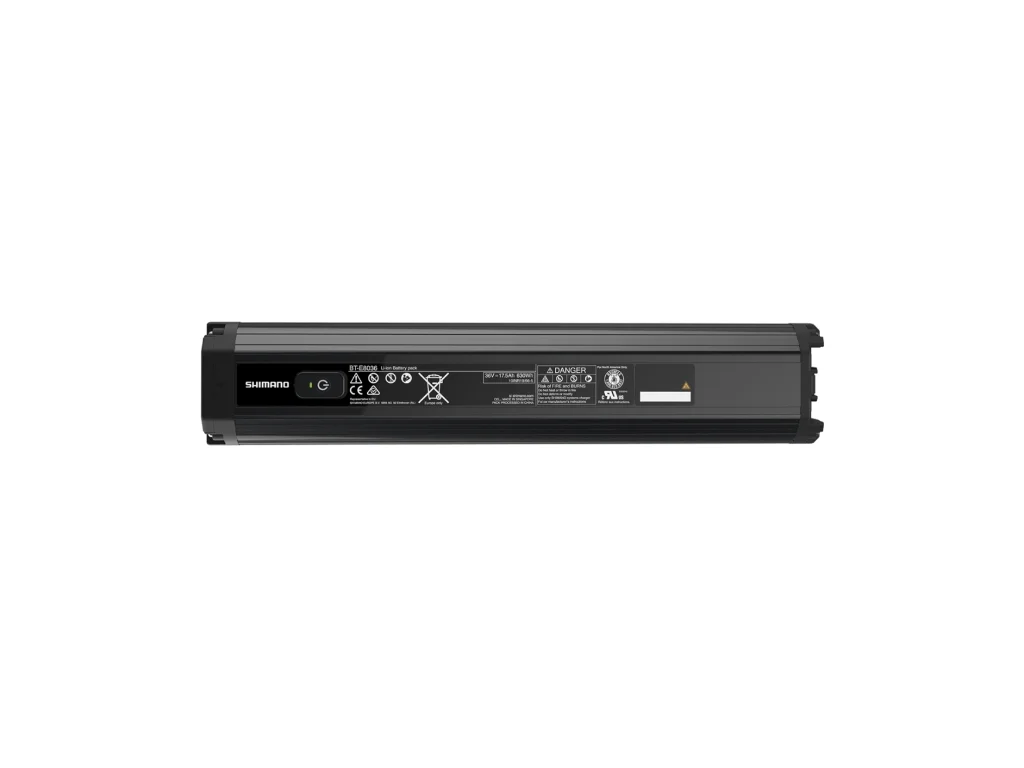
Shimano BT-E8036 · 630 Wh
Integrated Shimano STEPS Li-Ion battery 36 V / 17.5 Ah / 630 Wh, used for example on the MTF Mount 11.4 AUTO SHIFT.
| Criterion | MTF Li-Ion | Shimano Li-Ion |
|---|---|---|
| Long-term storage | Approximately 70–90% | Around 70% |
| Storage temperature | Approximately 10–25°C | Around 10–20°C according to the relevant Shimano guidelines |
| Check during long-term storage | Approximately every 2 months | Periodic check; follow the instructions for the specific battery |
| Fully discharged | Should not be stored this way | Charge as soon as possible |
An electric bike battery in winter
Cold weather can temporarily reduce the available capacity of a lithium-ion battery and, with it, the real range. This does not automatically mean the battery is damaged.
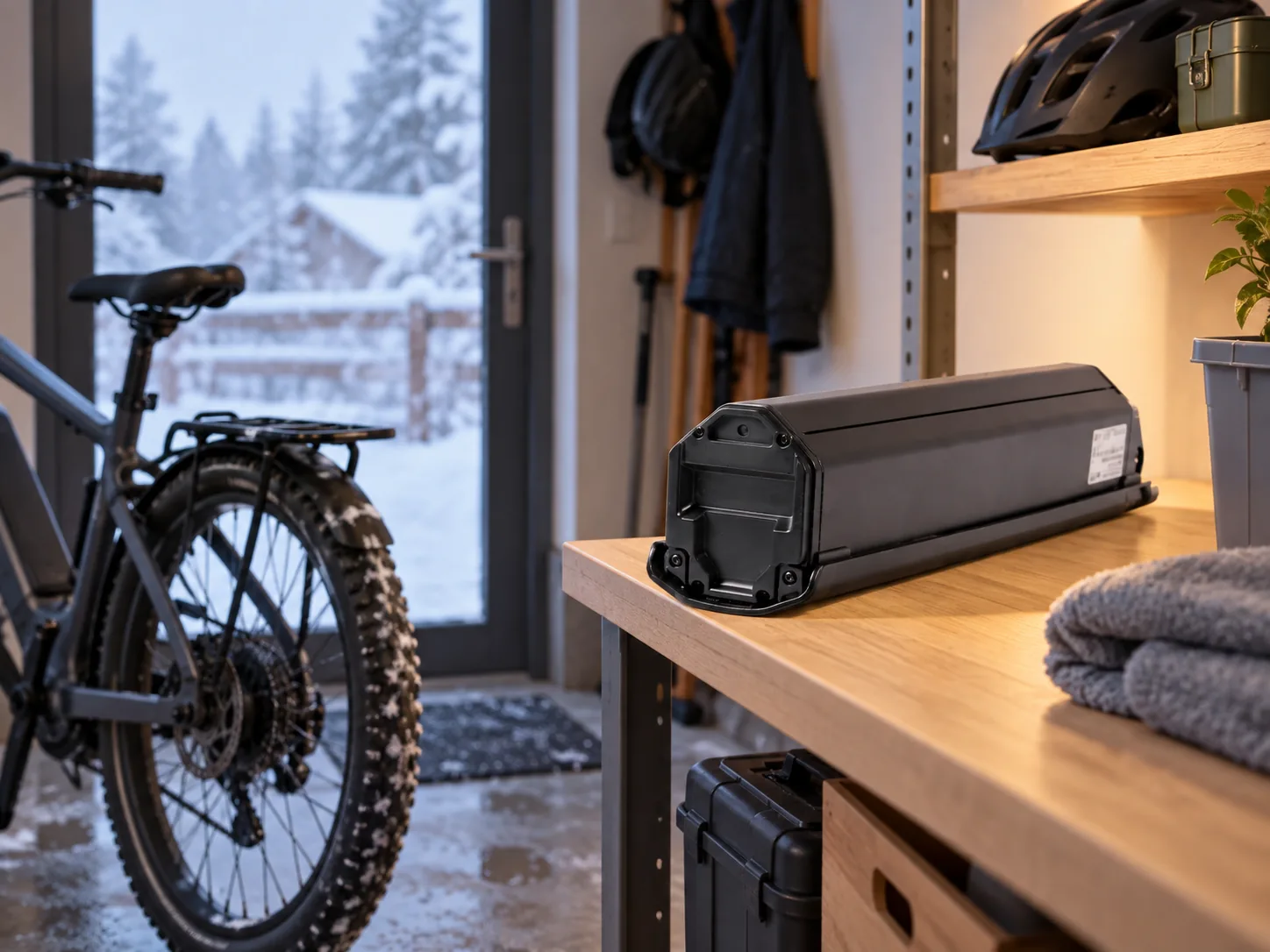
If you ride in winter
- Allow for a possibly lower real range.
- Leave a sensible reserve for long routes.
- After severe cold, let the battery reach a suitable temperature before charging.
- Carefully clean off salt, mud and moisture.
- Do not use a pressure washer on the electrical components.
If you do not ride in winter
- Do not leave the removable battery in a freezing room all winter.
- MTF: approximately 70–90% charge.
- MTF: approximately 10–25°C.
- Check the charge periodically.
- With MTF, top up roughly every two months.
You will find more on the link between temperature and real-world kilometres in our guide to electric bike range .
The battery in summer – why is high temperature a problem?
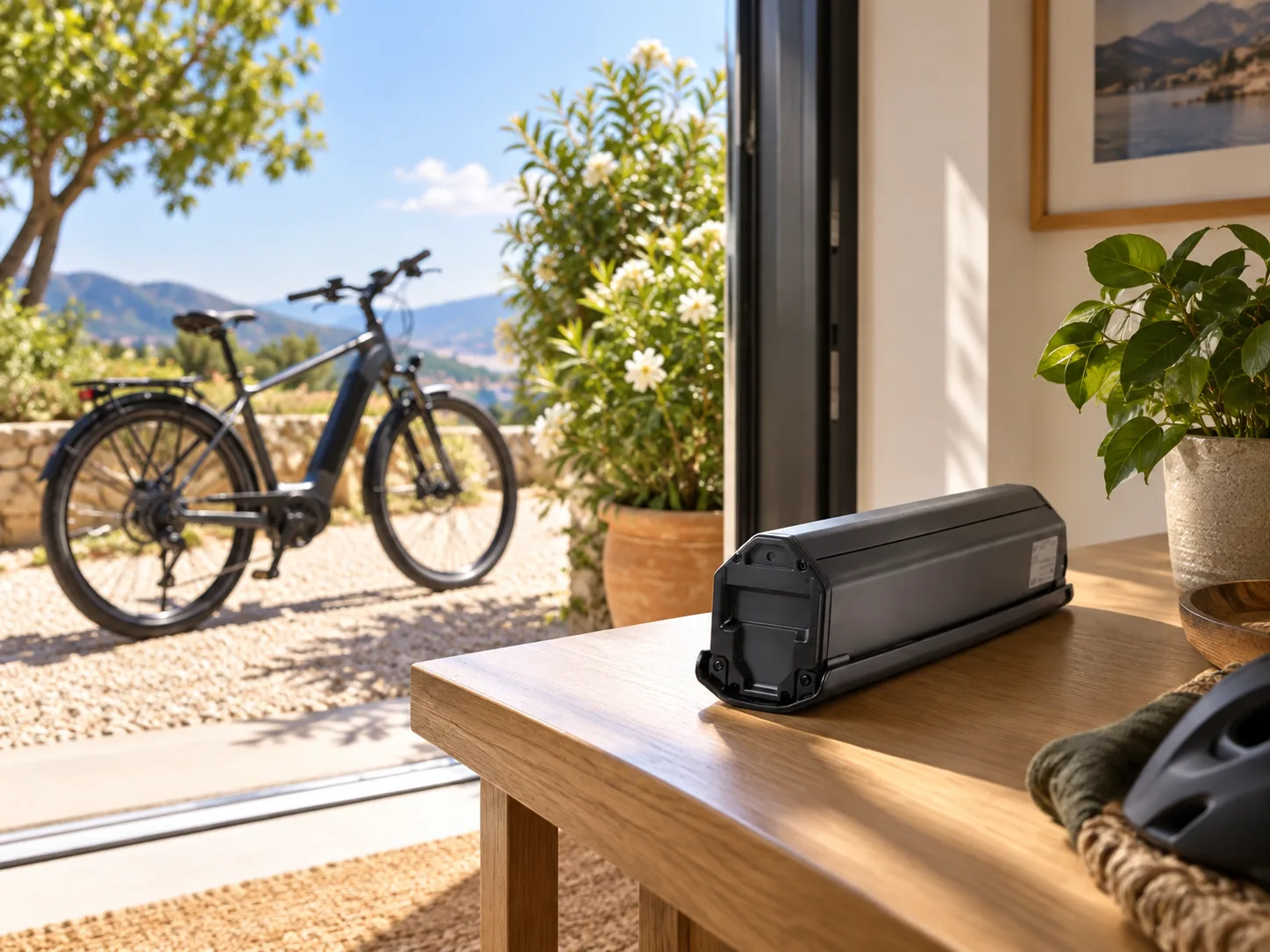
In summer, the main risk is excessive heat. Do not leave the battery for long periods in direct sunlight, near strong heat sources or in a closed car that heats up in the sun.
Spring and autumn – what should we check?
After winter storage
Before your first longer ride, check the charge level, the battery casing, the contacts, the charger and that the electrical system starts normally.
Before winter storage
Clean and dry the bike and the battery, choose a dry room and leave the battery at a suitable charge level according to the manufacturer.
How many years does an electric bike battery last?
For MTF batteries, Mountfield states an indicative service life of approximately 500–900 charge cycles, depending on the specific type.
This does not mean the battery suddenly stops working after a certain number of cycles. Over time, maximum capacity gradually decreases, and real-world range may decrease with it.
What does one charge cycle mean?
A charge cycle should not be understood simply as “I plugged in the charger once”. A cycle relates to the total amount of capacity used and restored.
That is exactly why several small top-ups do not necessarily mean several full cycles.
How can we extend the life of the battery?
- Do not leave it fully discharged for a long time.
- Protect it from excessive heat.
- Do not store it for long periods in severe cold.
- Charge it at a suitable temperature.
- Use the correct, compatible charger.
- Do not deliberately deep-discharge it for the purpose of “formatting”.
- Follow the recommendations for long-term storage.
- Protect the casing from impacts and mechanical damage.
Second-hand electric bike battery – is it worth it?
With a used battery, the biggest problem is often not visible from the outside – the unknown history.
You may not know how many years it has been in use, how many cycles it has, whether it has been left fully discharged, whether it has been stored in a hot car or a freezing garage, and whether its real capacity has already dropped significantly.
What should we check on a second-hand battery?
- the exact model and full compatibility;
- its age and origin;
- verifiable usage history, if available;
- actual remaining capacity, where the system allows diagnostics;
- signs of impact, deformation, moisture or repair;
- the correct charger;
- normal behaviour when charging and in use.
On some electric systems, professional diagnostics can provide information on the remaining capacity and the number of cycles. This is far more reliable than a claim such as “the battery holds a lot”.
How do we tell whether the battery is worn out or has a problem?
Shorter range on its own is not enough for a diagnosis. Cold, climbs, a high assistance level, weight, tyres and a different route can also reduce the distance covered.
Normal ageing
It is normal for maximum capacity to decrease gradually over time. If, under similar conditions, your range becomes gradually shorter over the years, this may be a natural result of ageing.
When should use be stopped?
If the battery suddenly starts switching off, refuses to charge or shows other unusual behaviour, the cause must be established before any further use.
Can an electric bike battery get wet?
Electric bikes are designed for normal outdoor use, but this does not mean the battery should be submerged in water or cleaned with a strong jet of water.
For cleaning, use a suitable soft damp cloth and protect the electrical contacts and connectors.
The most common electric bike battery mistakes
Deliberately discharging to 0%
This is not necessary with Li-Ion technology and should not be done for the purpose of “formatting”.
Leaving it discharged for months
Long-term storage at a very low charge level is not good practice.
A hot car
A closed car in summer can reach a very high temperature.
A freezing garage
Long-term winter storage in severe cold is not ideal.
Any random charger
A matching connector does not automatically mean electrical compatibility.
One rule for all batteries
Always check the instructions for your specific battery pack and charger.
Real MTF examples – different batteries, different systems
The current range shows well why capacity and system must be considered case by case.
| MTF model | Battery | System | Charger |
|---|---|---|---|
| MTF Cross 7.5 W | 705.6 or 882 Wh | MTF Li-Ion with Samsung cells | MTF 36 V / 3 A |
| MTF Mount 11.4 AUTO SHIFT | 630 Wh | Shimano STEPS BT-E8036 | 4 A |
This is also why we do not assume that a bike with a Bafang motor automatically has a Bafang battery. On the Cross 7.5 W, the motor is a Bafang M510, but the battery pack is an MTF Li-Ion with Samsung cells.
Frequently asked questions about the electric bike battery
How do you charge an electric bike battery correctly?
Use the intended or officially compatible charger, charge in a dry place at a suitable temperature and follow the instructions for your specific battery pack.
How long does an electric bike battery take to charge?
There is no universal time. It depends on the capacity, the starting charge level and the charger. For example, an 882 Wh battery needs more energy for a full charge than a considerably smaller battery pack at the same charging current.
Should the battery be charged after every ride?
Not necessarily. If the remaining charge is enough for your next ride, there is no technical need to charge it automatically after every short ride.
Does the battery need to drop to 0% before charging?
No. A modern Li-Ion battery can be topped up. Deliberate full discharge is not necessary.
Can an electric bike battery be topped up?
Yes. You can add charge before a longer route without first using up the remaining energy.
Should I always charge the battery to 100%?
No. A full charge is useful when you need the maximum available range. For long-term storage, follow the percentage recommended by the manufacturer.
Does a new battery need to be formatted?
No. A modern Li-Ion battery does not need several deliberate 0–100% cycles for the purpose of “formatting”.
Can the battery be charged while it is on the bike?
On models designed to allow this – yes. Follow the instructions for your specific bike and switch off the electrical system while charging.
Can the battery be charged when removed from the bike?
With removable MTF batteries – yes. This is especially convenient when the bike is kept in a garage, a cellar or another place without a suitable socket.
At what temperature should an MTF battery be charged?
For MTF, the instructions give approximately 0–45°C as the permitted range, and charging at normal room temperature is the better practical choice.
What should I do if the battery has been out in the cold?
Bring it into a dry room and let it reach a suitable temperature before you start charging.
What charge level should an MTF battery be stored at?
For long-term storage, MTF recommends a charge of approximately 70–90%.
How should I store a battery over winter?
In a dry place, at a moderate temperature and with a suitable charge level. For MTF, the guideline is approximately 10–25°C and 70–90% for long storage.
Can the battery stay in a cold garage?
If the garage reaches very low winter temperatures, it is not a suitable place for long-term storage of the removable battery.
How often should we check the battery in winter?
For long-term storage, MTF recommends a periodic check and top-up approximately every two months.
Can the battery stay in a car in summer?
It is not good practice. A closed car in the sun can heat up strongly, and high temperature is not good for a Li-Ion battery.
Does cold reduce an electric bike's range?
Yes. At low temperatures, the available capacity and range may be temporarily lower. This does not necessarily mean permanent damage.
How many cycles does an MTF battery last?
Mountfield indicates roughly 500–900 charge cycles, depending on the battery type. Real-world lifespan also depends on storage, temperature and how the battery is used.
How can I tell whether the battery is worn out?
A gradual drop in real-world range under similar conditions can be one sign of ageing. Compare on similar terrain, at a similar temperature, assistance level and load.
Is a second-hand e-bike battery worth buying?
Only if its condition, origin and compatibility can be reliably verified. With a used battery, an unknown history is a significant risk.
Can I use a different charger?
Only if it is officially compatible and meets the required specifications. Do not choose a charger by the shape of its connector alone.
Is it normal for the battery to warm up while charging?
Moderate warming can be normal. Unusually strong overheating, deformation, odour or smoke mean you must stop using the battery.
Can the battery be washed with water?
Do not submerge it and do not use a strong jet of water. Clean it carefully with a suitable soft, damp cloth.
Does the battery charge while we pedal?
Not on the current standard MTF e-bike configurations. The battery is recharged only with the appropriate external charger.
Is a bigger battery always better?
Not necessarily. A larger capacity gives a bigger energy reserve, but it usually also means more weight and a higher price. Your choice should match your real routes.
What is the difference between 705.6 Wh and 882 Wh?
882 Wh stores more energy and, under similar conditions, can deliver a longer range. However, the real difference depends on terrain, assistance level, temperature and load.
Does a Bafang motor mean the battery is a Bafang too?
No. For example, the MTF Cross 7.5 W uses a Bafang M510 motor, but an MTF Li-Ion battery with Samsung cells.
Sources and technical accuracy
The information in this guide is based on official technical materials from Mountfield/MTF and Shimano, as well as the current electric bike configurations published by MTF Bikes.
Where general advice in this guide differs from the instructions for your specific battery, charger or bike, follow the documentation of the specific manufacturer.
Choose an electric bike to match your real routes
Compare the current MTF models by purpose, motor, battery, range and frame size – from compact city bikes to mountain and trekking models with large energy capacity.
Explore the electric bikes


